
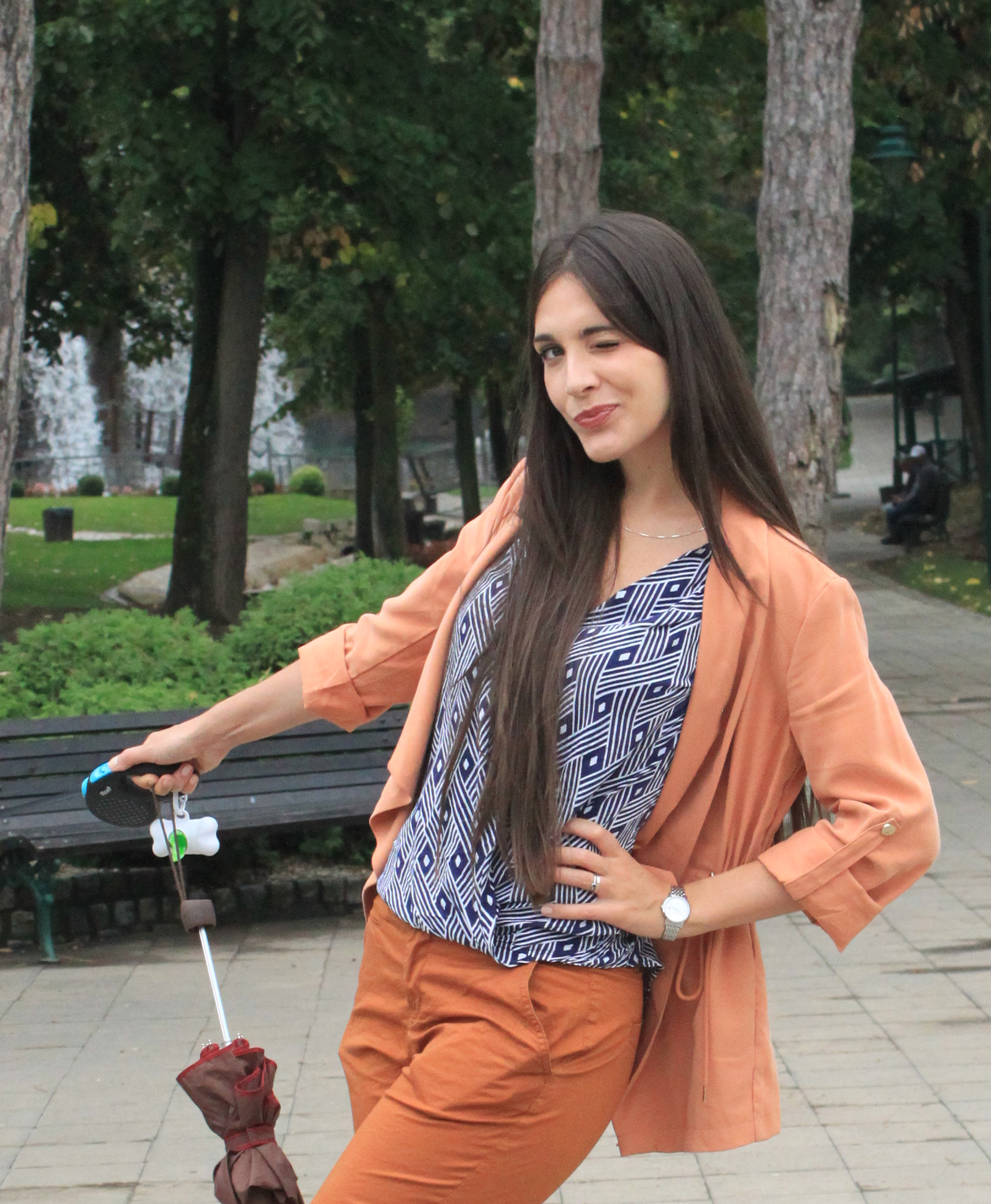
Kristina Denadic
Children's Illustrator
Who or what made you want to become an illustrator?
When I was three, I saw a Painter in an old animated movie, fixing the broken world with his magical paintbrush.
I said, "MOM! I want to be a painter!" and my journey through the world of art began at that point.
How and why did you decide to pursue illustration as your career?
After graduating from the University of Arts in Belgrade, I began posting my illustrations online. In 2018, an author approached me with her story and asked if I would like to illustrate her first children’s book "Are You a Baby Reindeer?". A year later, we created our second book together, and soon more authors began reaching out to me.
At the same time, I was working as a character designer and concept artist in the animation and video game industries. After illustrating 15 published books, I decided to leave my full-time position at an Austrian video game production company and fully dedicate myself to publishing.
A few months after leaving my job, I was represented by Shannon Associates LLC, which marked the beginning of my career as a full-time freelance children’s illustrator. I was honored to provide art direction for self-published books and to be involved in the printing process, where I gained valuable insight into how the entire publishing journey works.
Did you attend art school or undertake any other formal artistic training?
My academic artistic training started when I was 14. I enrolled in an art high school, studying costume design and figurative fine arts. Then I continued my studies of Fine Arts and Costume Design at the University of Arts in Belgrade, and started working in theater and on film. As a passionate reader and theater and film audience, I was studying character analysis and character development, which became my foundation of understanding how to build characters.
Meanwhile, I was taking Schoolism courses for learning foundations of drawing stylised character, illustration and lighting.
Was creativity part of your childhood?
As I decided to become a painter at age three, my mom enrolled me in kids’ art classes. I discovered clay, and besides drawing, painting, and sculpting, my grandma taught me how to design and sew miniature clothes for my Barbie dolls, so I could play with characters from my favorite books and cartoons. I was especially fascinated by historic costumes and fairy tales, and at 14, I joined an art high school as part of the first generation in the new costume design department.
Below is a drawing I made at age 3 or 4 of a model in contrapposto at a flea market buying chic clothes, and my mom says I titled it “A Chic Chick at the Flea Market.”
Have you always loved to draw?
Not only to draw, I also loved creating my own illustrated books with my own stories. As a neurodivergent child, I learned to write quite late, but since I really wanted to make my own books, my mom would help me with writing words - so I can literary draw words and symbols that looked like super interesting hieroglyphs to me.
I was told that in school I would learn how to write, and for years, I couldn't wait to start school. This image is supposed to be my book cover for my story "School is nice for kids and everyone".
Who or what have been some of your major artistic influences?
Ever since I can remember, I was copying illustrations from The Disney Golden Book Collection from 1990. I used to copy them as a child over and over again, until all the books from the collection fell apart. This was my first artistic influence.
As I started studying fine arts in high school and later at the university, I was drawn to realism. The more advanced and technically challenging, the better. I was copying old masters painting and drawings.
In terms of stylisation, my first influence was Art Noveau and Alphonse Mucha.
Today, I find inspiration in my fellow illustrator's work. I'm thrilled to discover and meet new illustrators.
Which books from your own childhood really stand out?
Oh, as I mentioned, all books from The Disney Golden Book Collection from 1990.
At my aunt's, there was another Disney book collection, called: Disney Choose Your Own Adventure, where you could pick your own path, and according to your choice, the book would have its ending. A cause and effect. How exciting!
Do you have a favourite picture book or recall one of the first picture books you saw?
Besides the ones I mentioned, I loved Slavic Folklore books. They were really scary, with Baba Yaga living in a remote house with chicken legs.
Who or what has been your greatest mentor?
Great question. From my first art mentor when I was just 6, to the professors I had in art high school when I was between 14 and 18 years old, and later my university professors, everyone contributed to my artistic development and helped me develop my skills, strengthen my intention, and build my self-esteem in pursuing an art career. I’m forever grateful to everyone who mentored me and believed in me.
But above all, my mom has always been my greatest mentor, and without her belief, joy, and support, my journey would not be the same, as she has been my cornerstone throughout all of those developmental periods, helping me push through many difficult decisions and times in pursuing the arts.
What was your first commission as a professional illustrator?
Right after graduating, I was invited to do a test project: a very complex fantasy illustration with several characters in an imaginary landscape, created for a job application that I didn’t win. I was, however, awarded a very symbolic prize, and my motivation was through the roof!
Describe your working technique and how you came to perfect it.
My foundation is in classical realism and fine arts. Stylization came many years later. When I started taking Schoolism classes, I had already transitioned from traditional to digital media, and, combined with workshops at La Galeria Roja, I was mentored to identify my blind spots and understand that the key lies in simplicity. Easier said than done when you come from a heavily detailed and realistic background. However, with years of practice, I can say that I feel comfortable working in both simple and complex illustration styles, and that the key is in devotion, patience and practice - and listening to mentors!
What piece of software or hardware could you not live without and why?
Photoshop, absolutely. I often switch from Procreate to Photoshop, the best of the best.
What is your favourite medium to work with and why?
I love pencil drawing. I’m not gonna lie, the digital medium is so much faster compared to traditional. If I could, I’d do all my work traditionally, but production simply doesn’t have the time or budget to support that process. However, I still get to treat myself with proper sketching during the brainstorming phase, and I'm trying to implement as much of traditional work as possible in my final pieces.
Graphite and color pencil sketching matters to me because the slower, physical process gradually builds hyperfocused type of presence that got me into drawing in the first place. It takes time, that’s true, but patience is the key to a deeper connection between inner feelings towards the subject, and my hand's outer expression.
In that process, many unpredictable things happen. I love it when my hand shows a new unconscious material, and when it takes different directions from what I initially planned. And I love how little it forgives while revealing everything.
Digital speed and perfection can never replace that.
Do you keep a sketch book?
Not only have I kept all my sketchbooks since I was 14 when my formal art training begun, but my mom has also kept most of my childhood sketchbooks and drawings. These are priceless memories.
Connecting with your inner child and younger self is, I think, one of the most effective ways to check whether you are on the right path in life. When I look at my old drawings and paintings, I not only ask myself what my younger self would say to me, but I can also feel the presence of an pristine flow of creativity I had back then.
Tell us about the creation of your favourite character from one of your books.
A few months ago, I began a personal project inspired by The Chronicles of Narnia: The Lion, the Witch and the Wardrobe.
While designing characters, I also studied literary theory on character development and analyzed what actually makes the most famous fictional characters so believable and memorable. This led me to examine the characters in Narnia more closely.
The process inspired an illustrated research project on building strong children’s characters, exploring why some book characters feel flat and fail to resonate with audiences, while others stay with us for life, even when they are flawed, emotionally driven, and shaped by inner conflict, such as Edmund Pevensie.
I studied how inner conflict influences characters’ choices, which in turn causes the plot, and I used this research to design characters that contrast with one another. Here you can see character sheets for Lucy and Edmund Pevensie.
What I enjoyed most was researching a character’s growth potential, the key factors behind transformation, and how to implement them into my own character designs.
How many times do you tend to draw a character until you are happy with it?
My process includes sketches, color variations, and expression sheets, and I usually arrive at the final character quite early on due to my understanding of character development and my trust in the gut feeling of how a character would express their personality most authentically.
What helps a lot is receiving a character bio with the writer’s perspective on the character’s inner world, including thoughts and analysis that are not directly stated in the book itself. I especially enjoy characters with contrasting personalities, where they see themselves one way, while the world around them sees them differently.
So, to answer the question, I draw a character as many times as needed until they feel authentic in both appearance and expression. I prefer to resolve this during the sketch phase, allowing the character development stage to receive the focused time it deserves in an efficient way.
Which project has been most instrumental in developing your personal style?
All my projects have taught me more than any art course could in terms of developing my style. Like all artists, I have my own visual taste, and when I look back I can say that my art style has remained more or less consistent throughout the years. I never intended to develop a style, it simply happened the way it always does - naturally on its own.
Talk us through the process of creating one of your latest illustrations or books.
My workflow depends on whether I’m working with a traditional publisher or on a self-published project.
When working with a publisher, I usually receive a defined number and type of illustrations, a prepared book layout, illustration dimensions, and illustration briefs. The work is divided into stages, and once the final revisions are approved, I deliver the finished illustrations. I’m not very involved in the printing process, and from the moment I submit the artwork, I can only wait for the book to be released.
When it comes to self-publishing, I often handle art direction alongside the illustrations, and I work closely with a book designer to make sure everything aligns with the initial vision and is ready for printing. This process gives me more artistic freedom, and I love that I always learn something new about the entire process of preparing a book for the market.
How long does it take on average for you to finish a spread, from initial sketch to final colour?
Depending on the complexity, a spread can take anywhere from one day to up to 10 days. I’m currently working on a highly detailed, painterly-style map double-spread illustration that will probably take around two weeks because of the many details and locations that need to be designed and composed cohesively.
At other times, there are simpler spreads with only a few elements, created to emphasize an important expression or a moment of realization, for example, and those do not take as much time to illustrate.
It mainly depends on the message and the amount of information a spread needs to communicate to the audience. We’re also seeing more and more variation in rhythm across books, including both highly complex and very simple spreads, in order to tell the story in the most effective way.
What do you hope children take away from your drawings?
I hope children feel supported in their authentic experience, stay playful and creative, and feel emotionally seen, with the freedom to experience curiosity, fear, tenderness, loneliness, or joy without shame.
What do you do in your spare time?
Besides arts and books, I am passionate about psychology. I am currently finishing my second year of an educational program at the Institute of Integrative Core Body Psychotherapy. I also love art therapy very much. I combine my knowledge and experience in my work, focusing on creating books that support a child’s emotional, cognitive, and neurological healthy development, hoping to help them build a better world than the one we leave for them - once it's their time to be independent individuals, and to be a good support and companion to the world around them, but to never lose playfulness and creativity.
What is your favourite children’s book and why?
As I'm answering these questions, I can't stop thinking of my memory of Peter Pan in Neverland (Disney Choose Your Own Adventure). I think it's because of the way how impressed I've been for many years with the way you can choose your anventure, and where the story would end based on your choices. I had many other favorite books, but today this is the one I think about the most. And I wish there are more books like that, that a child can remember for the rest of their lives, and say in their 30's "that's the first favorite book I can think of"
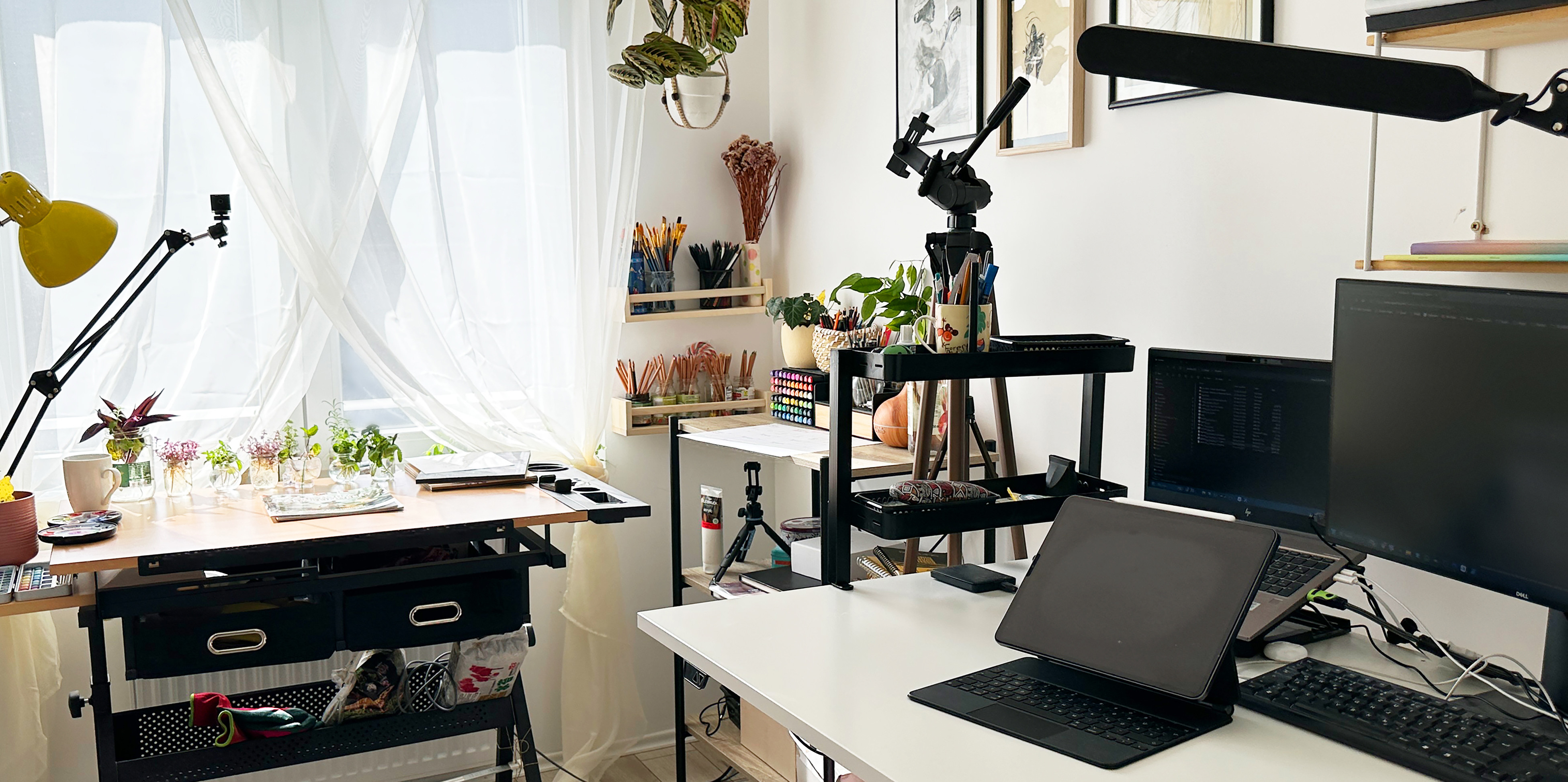
Take us behind the scenes and describe your studio / workspace.
I combine traditional and digital media in my workflow. Although working digitally is more cost-effective, I prefer to slow down in the sketching phase and develop characters and scenes by hand. When sketches are approved, I like to create a physical book dummy, as I am eager to get as close as possible to the reader’s experience when holding the final book in their hands. This allows me to connect more deeply with the story and its characters, to sense the atmosphere, and to bring a level of authenticity that the speed of digital tools alone doesn’t always allow.
In later stages, I transition into Photoshop and Procreate, where I refine the composition and incorporate text placeholders into spreads to better envision the final layout of the book.
What would you say is a distinguishing feature of your artwork?
I’ve worked across different creative and entertainment industries, from which I bring various knowledge and experience into my book illustrations - not only about illustrating, but also about the audience's experience. I specialize in character design, and my understanding of character development for theatre and film has helped me develop an eye for identifying a character’s core beliefs, hopes, fears, and weaknesses, which are the elements that are not always directly stated in the text.
I treat each book as a small theatre stage, inviting the audience to engage as if the performance is unfolding before their eyes, so they experience the story not only as passive observers, but to also become emotionally invested in the characters and the magic of the imaginary world.
Where do you get the ideas for your characters?
From the story itself and the character bios. I try to read the manuscript as if I’ve never experienced anything like this specific story before, just like stepping into a slightly strange dream, and then I can imagine myself becoming that character. Seeing their world through their eyes. This is why I love collaborating with authors, so many unexpected ideas may occur.
I don’t overthink it, I follow my first impressions, the ones that feel a little strange, emotional, or sometimes even unsettling. I sketch characters in different poses quickly, almost trying to catch something before it disappears.
Which 4 words would you use to describe your illustration portfolio?
Painterly, dynamic, narrative, connecting
What advice would you offer someone just starting out as a children’s illustrator?
Don’t just draw whatever you like and hope to land a project. Read books, visit local book fairs, connect with fellow illustrators, writers, and publishers in person, and ask for feedback. See where your current work stands and which market suits you best.
Check your local bookstores and libraries to see which books are trending. This doesn’t mean you should copy trends, but it helps you understand what audiences are interested in reading and can guide your path more effectively.
Also, join professional associations and network with other members. You’ll be surprised by how many industry professionals you can meet and what kinds of opportunities can come from those connections.
How do you overcome a creative block?
Creative blocks often come from perfectionism and fear of mistakes. Through art therapy, I learned to accept them as a natural part of the creative process and to move beyond overthinking by reconnecting with instinct, emotion, and subconscious expression through working with all types of art materials.